
 Join the IQOS user group
Is IQOS legal in Thailand?
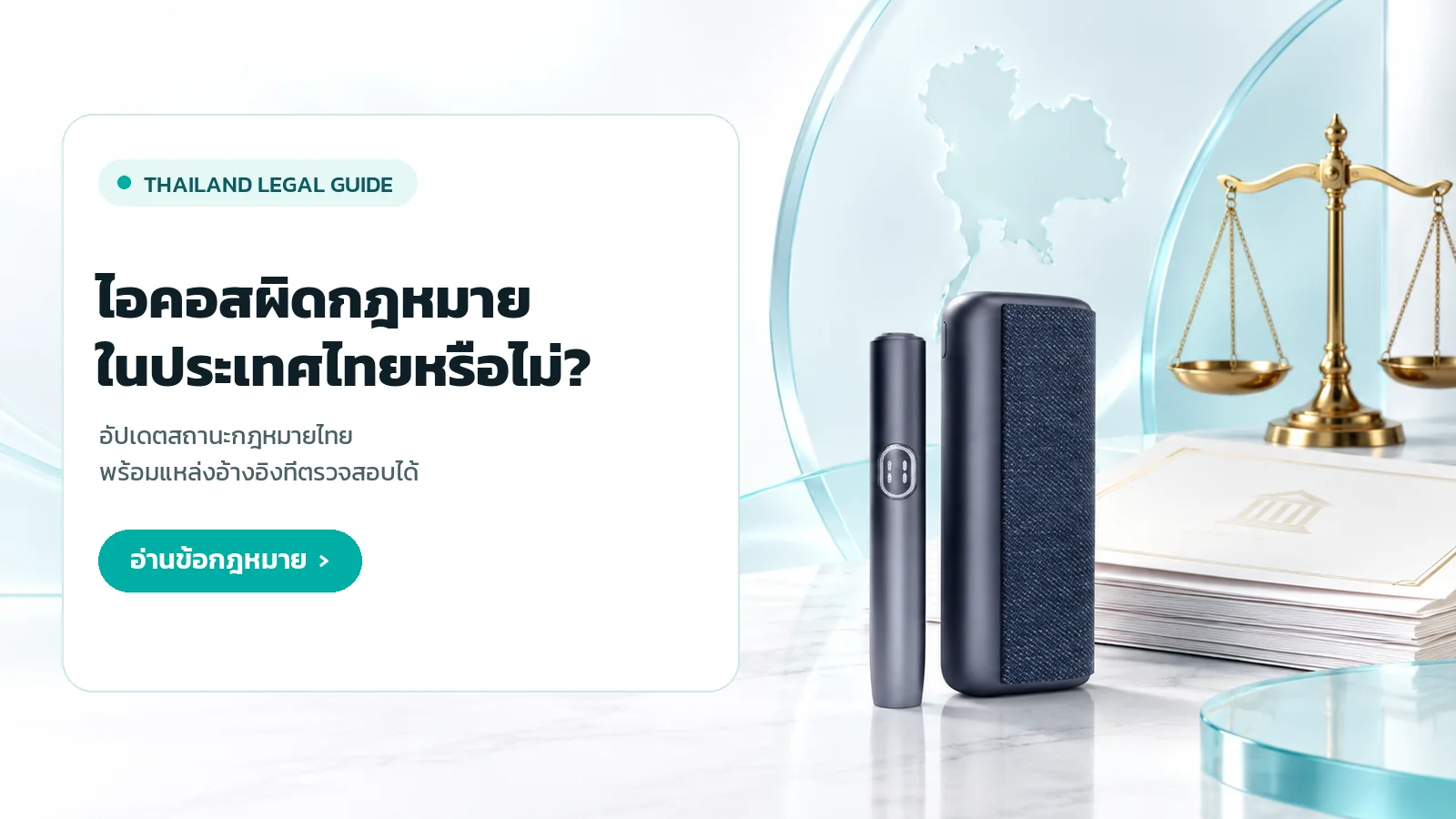
No. Thai law prohibits both importing IQOS-type devices into the country and selling or servicing them within Thailand. International tobacco-law trackers that monitor Thailand's regulations classify heated tobacco products, including IQOS, as falling within the scope of the country's e-cigarette ban. There is no stated exemption for personal use.
This conclusion is based on two separate Thai legal instruments described in detail below, not on hearsay or forum discussion. Both instruments are publicly available in unofficial English translation through an international tobacco-control law tracker.
What exactly does the 2024 decree prohibit?
Decree No. 24/2024 of Thailand's Committee on Safety of Products and Services, Article 3, prohibits entrepreneurs from manufacturing for sale, selling, or servicing baraku, e-baraku, or e-cigarettes, or the chemical compounds and liquids used in them. The decree defines 'e-baraku or e-cigarette' broadly as any device that uses electrical energy to produce smoke, steam, or vapor for inhalation in the same way as smoking a cigarette.
That definition does not name any specific brand or technology, but its wording — any electrically powered device producing vapor for inhalation — is broad enough that international trackers treat heated tobacco devices like IQOS as covered by it, alongside liquid vapes. The decree was issued under Section 29/9 of Thailand's Consumer Protection Act B.E. 2522 (1979), as amended, and took effect on 8 July 2024, published in the Government Gazette on 18 July 2024.
Which law covers bringing IQOS into Thailand?
A separate, older instrument covers importing: the Notification of the Ministry of Commerce Prohibition of Importing Hookah and Electronic Hookah or Electronic Cigarette into Thailand B.E. 2557 (2014), issued under the Export and Import of Goods Act B.E. 2522 (1979). Clause 4 of that notification states that electronic hookahs and electronic cigarettes are prohibited goods for import into Thailand.
Clause 3 of the same notification defines 'Electronic Hookah or Electronic cigarette' as a device that uses electrical power to create vapor similar to cigarette smoke, used for smoking in the same way as a cigarette, referencing a specific customs tariff code. The notification was signed on 12 December 2014, published in the Government Gazette on 24 December 2014, and took effect the day after publication. Nothing in its text suggests an exception for personal luggage or tourist use.
What changed between the 2015 order and the 2024 decree?
The 2024 decree formally revoked the earlier one. Article 1 of Decree No. 24/2024 states that it revokes the Office of Consumer Protection Board's Decree No. 9/2015 (dated 28 January 2015), which had banned sale and servicing of the same product categories but did not cover manufacturing for sale and lacked clear definitions of e-baraku and e-cigarettes.
Some older secondary sources online still cite the 2015 order as the current rule. Based on the decree's own text, that order is no longer in force — Decree No. 24/2024 is the operative instrument for the manufacturing-for-sale, sale, and servicing ban as of the most recent check against an international tobacco-law tracker (updated 30 September 2025). The 2014 import notification, by contrast, is a separate instrument and there is no indication in that tracker that it has been revoked.
Is IQOS legal for tourists visiting Thailand?
Neither instrument carves out an exception for tourists or short-term visitors. The import notification prohibits bringing electronic cigarettes and heated tobacco devices into the country regardless of who is carrying them, and the 2024 decree prohibits sale and servicing regardless of the buyer's nationality or length of stay.
This site does not offer guidance on how enforcement is applied in practice, how thoroughly luggage is checked, or how to avoid detection — that framing is out of scope for a page explaining what the law says. The straightforward reading of the text is that the prohibited activity is prohibited for any traveler, tourist or resident alike.
What are the penalties under Thai law?
Penalties vary by instrument and by the nature of the violation, and generally include both fines and imprisonment. The 2024 decree's own published text references enforcement provisions of the Consumer Protection Act with imprisonment terms and fines that scale up when harm to health results. This site has not independently verified a specific penalty figure for an individual traveler's personal possession, so that particular scenario is described only in general terms below.
The official English translation of Decree No. 24/2024 includes a note referencing Sections 56/4 and 56/6 of the Consumer Protection Act: an entrepreneur who fails to comply with a Safety Committee order faces imprisonment of up to five years and/or a fine of up to 800,000 baht, rising to imprisonment of one to ten years and a fine of 200,000 to 2,000,000 baht in cases that cause death. Those figures relate to the Act's enforcement mechanism for entrepreneurs and Safety Committee orders, not a separately labelled penalty for a tourist's personal import — that specific figure was not found in the primary text reviewed for this page. Penalties under the separate 2014 import notification fall under Thailand's customs and import-export legal framework, which this page has not verified in enough detail to state a specific figure.
Where can I read the official legal text myself?
Both instruments are available in unofficial English translation through the Campaign for Tobacco-Free Kids' tobaccocontrollaws.org legislation database, which links directly to scanned Government Gazette PDFs. This page links to that database rather than to any Thai retail or vaping site, to keep the sourcing independent of anyone with a commercial interest in the answer.
Readers who need an answer for a specific personal situation, rather than general background, should contact a Thailand-licensed lawyer or the relevant Thai government authority directly. This page is written for general information only and is reviewed periodically, but it cannot guarantee it reflects the very latest regulatory change at the moment you are reading it.
| Scenario | What the law's text says | Exception stated in the text? |
|---|---|---|
| Bringing an IQOS device in checked or carry-on luggage | Import of e-cigarette type devices is prohibited (2014 notification, Clause 4) | None found |
| Buying IQOS locally in Thailand | Sale and servicing of e-cigarette type products is prohibited (Decree 24/2024, Art. 3) | None found |
| Carrying IQOS as a short-stay tourist | Same import and sale provisions apply regardless of length of stay | None found |
คำถามที่พบบ่อย
Is IQOS banned in Thailand, or just restricted?
Does Thai law treat IQOS differently from liquid vapes?
Is this page legal advice?
แหล่งอ้างอิง
- Campaign for Tobacco-Free Kids — tobaccocontrollaws.org, Thailand: heated tobacco products, main policies (updated 30 Sep 2025)
- Decree of the Committee on Safety of Products and Services No. 24/2024 (unofficial translation)
- Notification of the Ministry of Commerce — Prohibition of importing Hookah and Electronic Hookah or Electronic cigarette into Thailand B.E. 2557 (unofficial translation)
← Back to the Legal section · Back to the homepage
Join the IQOS User Group (Thai-language LINE group)
A space for IQOS users to exchange information with each other — not a commercial channel of any kind. For readers aged 20+ only. Note: this is a Thai-language LINE group.
Join the IQOS User Group (Thai-language LINE group)