
 Join the IQOS user group
Which topics does the IQOS guide section cover?
The section is built around six core articles: what kind of device IQOS is, how a single session works, what to prepare before first use, how charging works, how to clean and look after the device, and how to read flashing lights. Each one has clearly separated boundaries, so the same answer does not appear in two places. Newer explainers on related questions sit alongside them.
Recent additions include a plain-language page on heat-not-burn tobacco, a checklist for a device that will not charge, and a comparison of IQOS, glo and Ploom.
All of them follow the same rule: one question, one page, with dated sources underneath.
Each guide opens with a short direct answer, so you can stop reading as soon as your question is settled.
Where should someone new to IQOS begin reading?
Start with the article that explains what the device is and how it heats tobacco, because most other guides refer back to the difference between the two device families. After that, the first-time setup page covers the one-off steps for a new device. Readers who already own a device and have a specific problem can skip straight to the guide that matches the symptom.
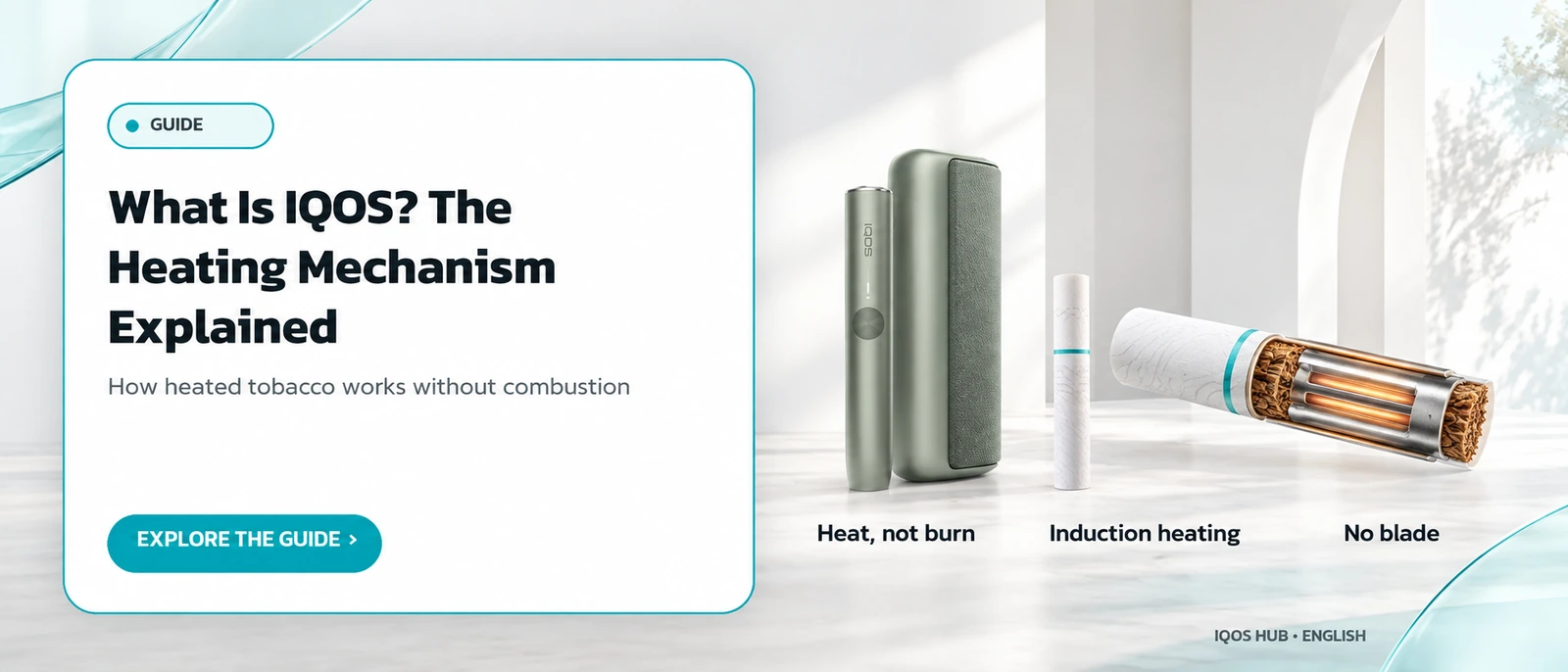
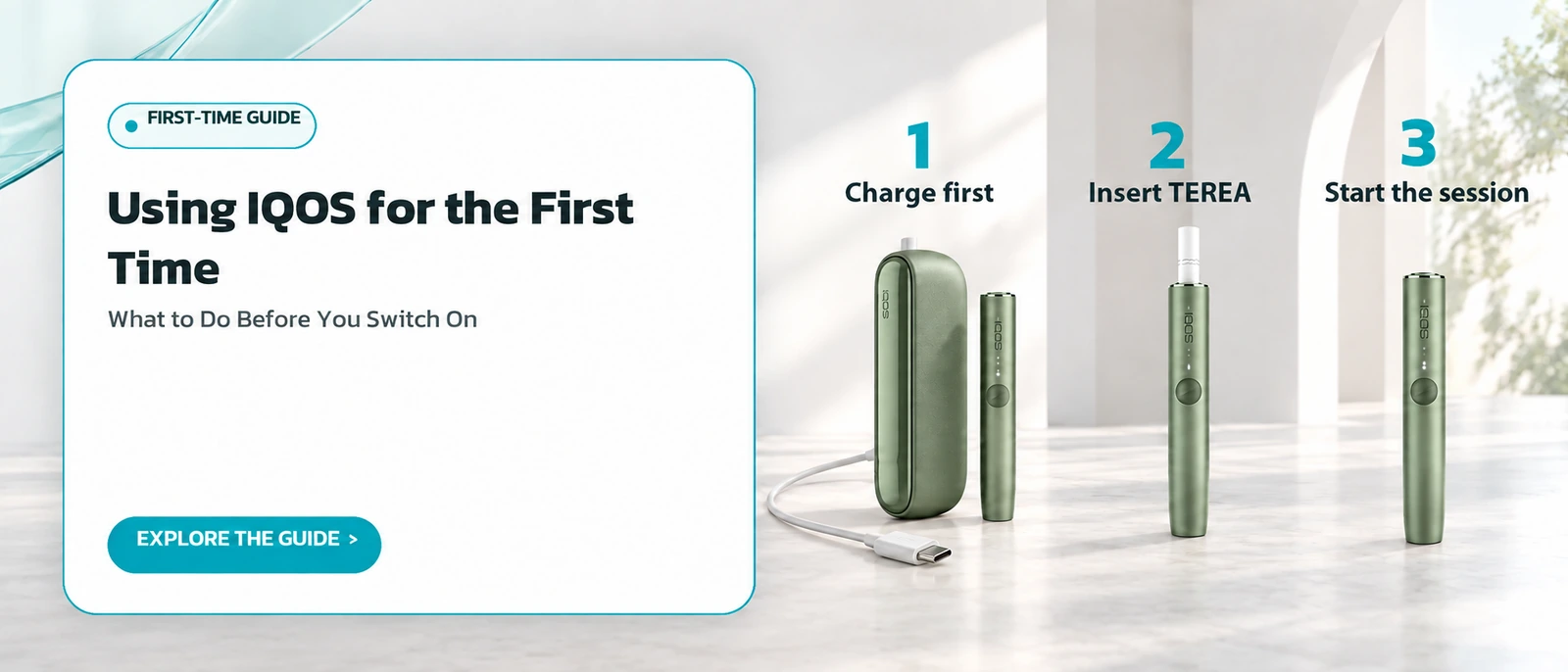
The mechanism explainer is What is IQOS?, and the one-off preparation steps are on using IQOS for the first time.
If you are unsure which family your device belongs to, the devices section lists the models by generation.
The two starting articles are short, and together they explain the vocabulary that the rest of the section uses.
How can the IQOS device be summed up in a few lines?
IQOS is an electronic device that heats real tobacco until it releases a nicotine-containing aerosol, without setting the tobacco alight. There are two main families. The older blade family pushes a metal blade inside the holder into the stick, while the ILUMA family uses induction to heat a metal element sealed inside the stick itself. That design choice shapes much of what follows in the other guides.
Because the heater sits in a different place in each family, cleaning routines, stick types and some fault symptoms differ as well.
The full technical picture, including a side-by-side table, is in our explainer on how IQOS works.
Readers who only need the headline can stop here; everyone else will find the details worth the extra minutes.
What does an ordinary IQOS session look like from start to finish?
A normal session starts with checking the battery lights, then inserting a tobacco stick and waiting for the light and vibration that signal the device is ready. You use it until a warning signal shows the session is nearly over, and then remove the used stick. The exact steps differ between the blade family and ILUMA, so the dedicated article handles each family separately.
That step-by-step walkthrough is the most detailed page in the section: how to use IQOS ILUMA.
It is worth reading before a first session, because the signals are easy to miss the first few times and each family uses its own pattern.
Keep in mind that the blade family and ILUMA signal readiness differently, which is why they are described apart.
Which steps only need doing once, before the very first stick?
For a new device you check that everything in the box is there, fully charge the pocket charger for the time given in the manual, then switch on and start the first stick. These steps happen once per device, which is why they have their own page. The first full charge, for example, takes longer than a routine top-up later on.
Readers with a brand-new device should open the first-use checklist before the regular session guide.
The routine steps that repeat every time are kept on a separate page so the two lists never get mixed up.
Doing them properly once means the daily routine afterwards is shorter, because nothing needs repeating from the start.
How are charging and device care split between the guides?
They are two separate articles. The charging guide is only about power: how long each part takes and what the battery lights mean. The cleaning guide is only about care after use. Daily charging of the pocket charger is recommended, while care depends on the family: ILUMA needs no blade cleaning because it has no blade, whereas blade models need regular cleaning.
Read charging times and battery lights for power questions, and cleaning each IQOS family for maintenance.
If power is the problem rather than routine, the not-charging checklist goes further.
Splitting them means each page stays short. Someone with a battery question never has to scroll past cleaning steps, and the reverse is true as well.
What is the first clue to check when an IQOS device misbehaves?
Look at the colour of the flashing light on the holder first: yellow, white or red. Each colour has its own meaning and its own fix, and only a red light calls for a reset using the set procedure. The troubleshooting article gathers every flashing pattern into one table, which is quicker to scan than reading a whole page while the device is in your hand.
Keep the IQOS light meanings table bookmarked for when something looks wrong.
It also covers a stick that will not start and a stick stuck in a blade device, with the point at which you should stop and contact official support.
Colour first, then the fix: that sequence saves time and avoids resetting a device that only needed charging.
Do these guides apply equally to every IQOS model?
Mostly they explain things per family, blade or ILUMA, because the two work differently. Where a guide gives exact figures, such as charging times, those come mainly from the ILUMA family, since that is where official documentation is clearest. Owners of blade models should confirm model-specific numbers in the manual for their own device rather than assume the ILUMA figures carry over.
None of this changes local law. For anyone in Thailand, official travel advice treats possessing or using a heat-not-burn device as illegal; details are on IQOS in Thailand.
Model differences are summarised on the device comparison.
Where no official number exists for a model, the guides leave it out rather than guess.
| Your question | Guide to open |
|---|---|
| How does IQOS work mechanically? | What is IQOS? |
| How do I run one session? | How to use IQOS ILUMA |
| I have a new device, what first? | Using IQOS for the first time |
| How do I charge it properly? | IQOS charging guide |
| How do I look after it? | IQOS cleaning guide |
| A light is flashing, what now? | IQOS troubleshooting |
Frequently asked questions
Are these IQOS guides suitable for someone who has never used the device?
Why is the guide section split into so many separate articles?
Which IQOS guide has the most step-by-step detail?
Which guide is best kept handy for quick reference?
Where do the charging times quoted in these guides come from?
Do the practical guides also cover the law in Thailand?
Sources
- How to Use and Charge IQOS ILUMA — IQOS UK
- IQOS ORIGINALS DUO vs IQOS ILUMA: What's the Difference? — IQOS UK
- Thailand travel advice: safety and security — GOV.UK
Read more
← Back to the Legal section · Back to the homepage
Join the IQOS User Group (Thai-language LINE group)
A space for IQOS users to exchange information with each other — not a commercial channel of any kind. For readers aged 20+ only. Note: this is a Thai-language LINE group.
Join the IQOS User Group (Thai-language LINE group)